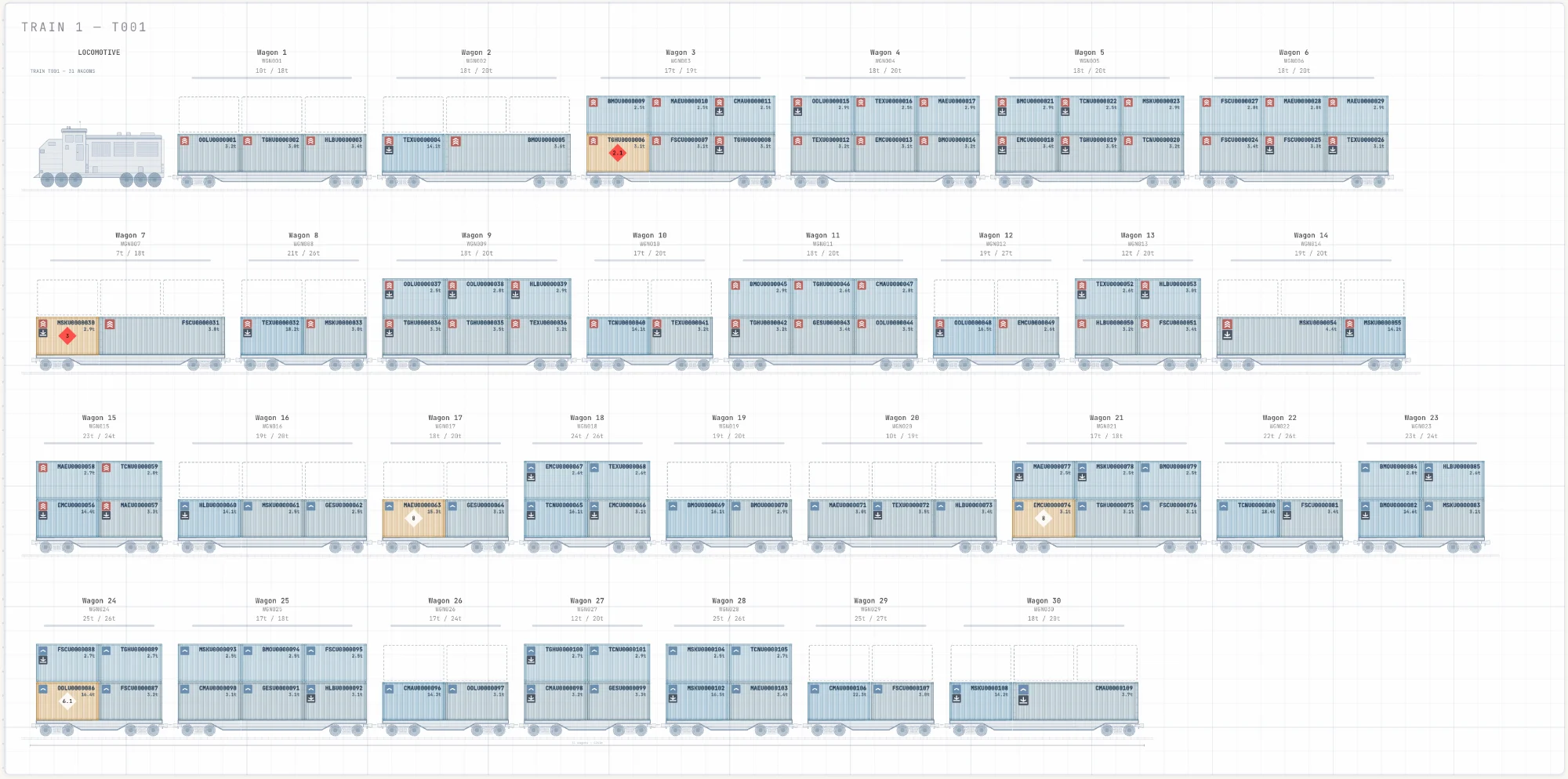
The Rail Loading Optimiser builds the load plan wagon by wagon from the containers due to move, within weight and axle limits, wagon type, destination sequencing and terminal handling rules. As each truck arrives at the terminal it works out the order of drop-offs and pick-ups that completes the visit in a single pass, and keeps a Pre-Plan of the whole train up to date as containers arrive.
Key features
- Wagon-by-wagon load plans: Each container is placed against the container lengths and platform configurations its wagon class allows, including oversized 46ft and 48ft containers and double stacking, within every wagon’s payload and axle weight limits.
- Dangerous goods separation built in: Separation rules derived from the Australian Dangerous Goods Code and the Australian Explosives Code are applied to every placement, at class level, substance level and for explosives. Where information is missing, the optimiser defaults to the more conservative outcome.
- Single-pass truck visits: As a truck enters the lane, the optimiser determines the sequence of drop-offs and pick-ups so the visit is completed in one forward pass, and shows the recommended steps in WaveSCM against the truck’s registration.
- Train Pre-Plan: A visual plan of how the whole train will be loaded, built from the containers already on board, those staged on the ground and those booked to arrive by truck. Oversized container and twist lock positions are known in advance, so the crew can set up the train before the containers arrive.
- Re-plans with minimal disruption: When an unexpected container arrives, or one arrives with a different weight or dangerous goods class, the Pre-Plan is regenerated from where it stands rather than from scratch, and every change is kept as a snapshot for later review.
- Route height limits respected: Stacking configurations that would exceed the maximum height of any segment on the train’s route are never recommended, and a train already in a non-compliant state is flagged to the user.
- Background housekeeping: Ground-staged containers are returned to the train as space becomes available, displaced continuing containers are restored before departure, and dangerous goods placements are monitored for compliance until the train leaves.
- Escalation, not silent compromise: Where no compliant placement exists, the optimiser explains why and escalates to the despatcher rather than making a suboptimal or non-compliant move.
- Your people stay in control: Recommendations are advisory. Staff create the corresponding WaveSCM jobs with one click per step, or for the whole visit at once, and access is governed by WaveSCM user group permissions.
Benefits
- More payload on each service: Better use of every wagon slot and priority cut on every departure.
- Fewer late reworks: Less rehandling and fewer extra lane passes caused by an incorrect first sequence.
- Consistent dangerous goods compliance: The same separation rules applied on every placement, reducing the risk of human error in high-consequence situations.
- Faster truck turnaround: Single-pass visits cut truck dwell time in the lane.
- A repeatable result: Good loading no longer depends on one experienced planner being available, freeing despatchers to focus on exceptions and terminal coordination.
To schedule a demo or learn more about WaveSCM, please contact us:
Request a Demo